Kitchen Makeover: 4-Tier Budget Guide (2026)
Kitchen makeover without a demo: 4 budget tiers ($100 to $3,300), paint cabinets, adhesive backsplash, counter resurface. Test 10 looks before you buy.
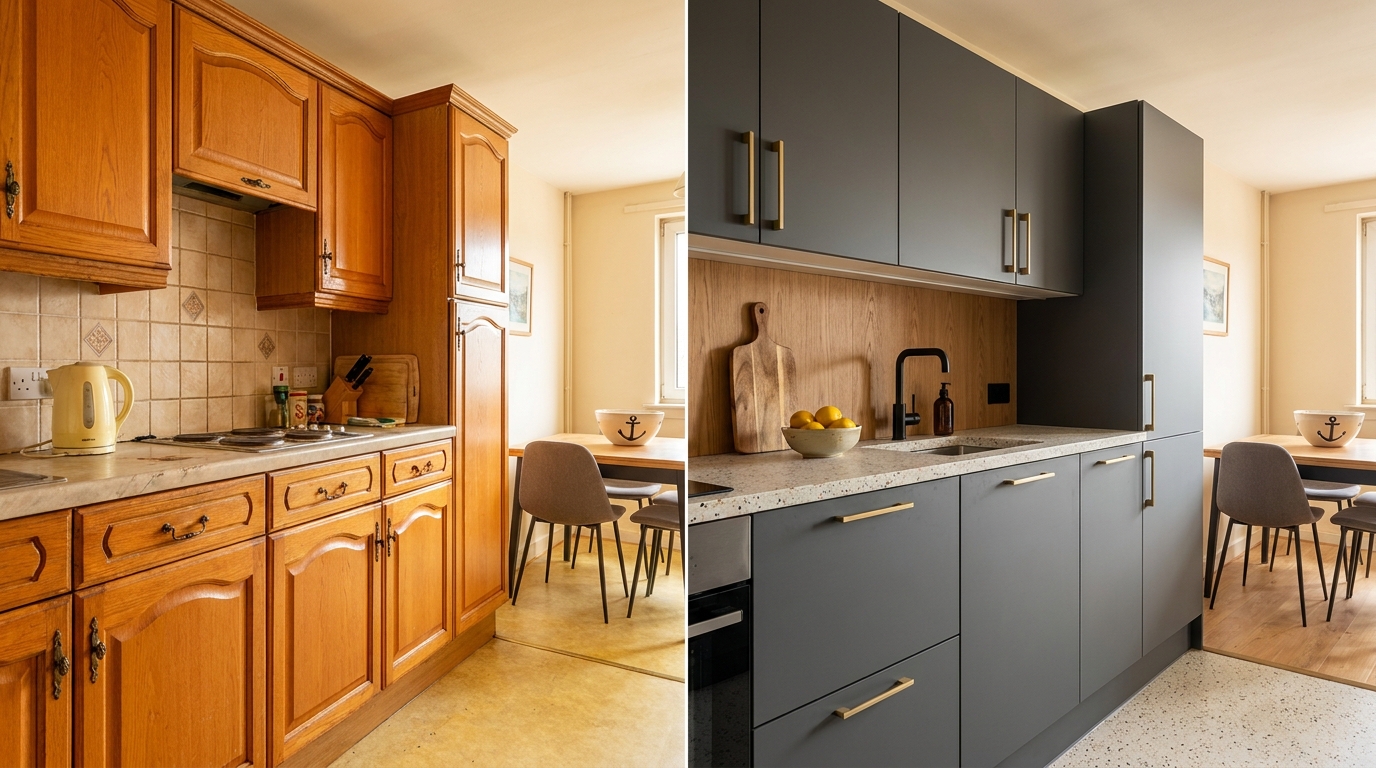
A kitchen makeover in 2026 means working through four budget tiers: $110 (paint), $550 (+ hardware + peel-stick backsplash), $1,600 (+ resurfaced counter), $3,300 (+ new cabinet fronts). Test 10 looks on a photo of your actual kitchen with Homeify before spending $15,000 on a remodel.
The kitchen makeover method, broken into 4 budget tiers
A fully installed new kitchen in the US runs between $12,000 and $35,000 in 2026 depending on cabinet grade and counter material, per NKBA trend reports. A staged makeover that keeps the cabinet boxes costs $100 to $3,300 and gets you roughly 80 percent of the visual impact. The trick is treating it as four discrete tiers and stopping at the one your kitchen looks good at, instead of drifting toward a full remodel because you already started.
The four tiers: $110 (paint), $550 (+ hardware + peel-and-stick backsplash), $1,600 (+ resurfaced counter), $3,300 (+ new cabinet fronts). Every tier fits inside one or two weekends, with no plumbing changes and no cabinet boxes pulled off the wall. The single most expensive mistake is the wrong paint color: $75 of cabinet paint, six hours of labor, and two years of regret every time the morning light hits. Before you buy the paint, upload a photo of your kitchen to Homeify and try 10 finishes on the real room — same angle, same light, same furniture.
Tier $110 — Paint the cabinet fronts
Painting the cabinet fronts changes 80 percent of what you see for about $110. This is the most efficient kitchen cabinet makeover on the market — no other single change carries this much weight for the money. You need a cabinet-grade paint made for kitchens (Benjamin Moore Advance, Behr Cabinet & Trim Enamel, Rust-Oleum Cabinet Transformations) — wall paint will chip within weeks where hands touch, grease lands, and water splashes.
Prep is half the job
Prep is what decides whether the finish holds up for five years or peels in six months. Remove every door and drawer front, label the hinges, degrease everything with TSP or Krud Kutter, rinse, let it dry for two hours. Then 120-grit sanding + bonding primer — Zinsser B-I-N shellac primer on laminate and thermofoil, oil-based INSL-X Cabinet Coat Primer on wood. Skip the primer and the color will lift off in strips the first time someone wipes a spill.
Color choice — where AI saves you from regret
The most-tested cabinet colors on Homeify in 2026 are sage green, deep teal, warm off-white, and matte charcoal. Matte black looks incredible in a kitchen with two windows and north light, and turns into a cave in a windowless galley — this is exactly the kind of thing you can only see by previewing it on your actual room. For the darker end of the spectrum, the black kitchen inspiration gallery shows when it works and when it fights the room.
Application — three thin coats, not two thick ones
Use a microfiber mini-roller for flat panels and a sash brush for corners and profile details. Go three thin coats, not two thick ones — fewer drips, a harder cure, and six hours of dry time between coats. Budget one weekend for ten cabinet fronts, $60 to $70 of paint (one quart of Advance covers 14 to 16 fronts), and $20 in rollers, liners, and tack cloths. Total: $90 to $110.
Tier $550 — Hardware, peel-and-stick backsplash, and the small stuff
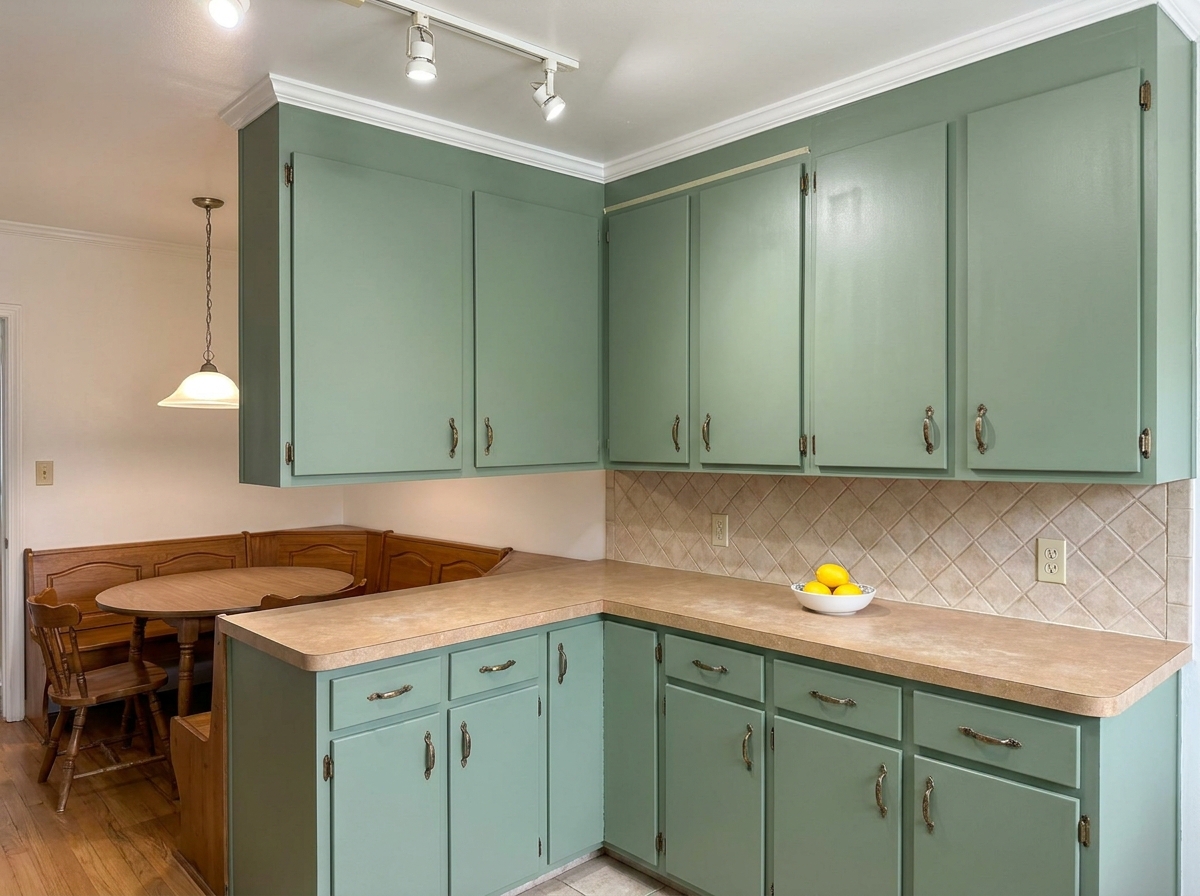
The combination of new hardware and a peel-and-stick backsplash transforms the room for another $440 on top of the paint — the best visual-impact-per-dollar ratio of any tier. All of it is renter-safe. Nothing is drilled that was not drilled already, nothing is torn out, the old tile stays under the new surface.
Swap the pulls — 15 minutes, huge read
Unscrew the old pulls, measure the center-to-center hole spacing (almost always 3 inches / 76 mm or 5 inches / 128 mm on larger drawers), and order matching spacing so you never fill or drill a hole. Unlacquered brass, matte black, and cognac leather are the three finishes trending in 2026 kitchen makeover ideas. Expect $30 to $80 for eight pulls at big-box stores, or $15 to $25 each for designer lines from Rejuvenation, Anthropologie, or Lost & Found Hardware.
Cover the backsplash without breaking tile
Two no-demo routes. A peel-and-stick vinyl backsplash (Smart Tiles, StickerMuSH, or d-c-fix) goes over clean, dry existing tile — $15 to $25 per linear foot at 18 inches of height, five to seven years of wear. Cement-tile patterns, zellige white, and Carrara marble veins dominate the US SERP for good reason. The alternative is an oiled-wood accent panel or stainless steel peel-stick sheet on a thin substrate, closer to $50 per linear foot, for a more custom look.
Small details that change the whole room
A matte black or unlacquered brass faucet (Kraus, Delta, or Kingston Brass at $90 to $220) changes how the sink reads from across the room. An under-cabinet IKEA Kungsfors rail with S-hooks ($30) pulls knives and dish towels off the counter. A 3000K under-cabinet LED strip ($40 at Govee or Philips Hue) adds the designed-kitchen warmth that used to require a lighting plan. None of this requires an electrician if you use plug-in fixtures.
Tier $1,600 — Resurface the countertop instead of replacing it
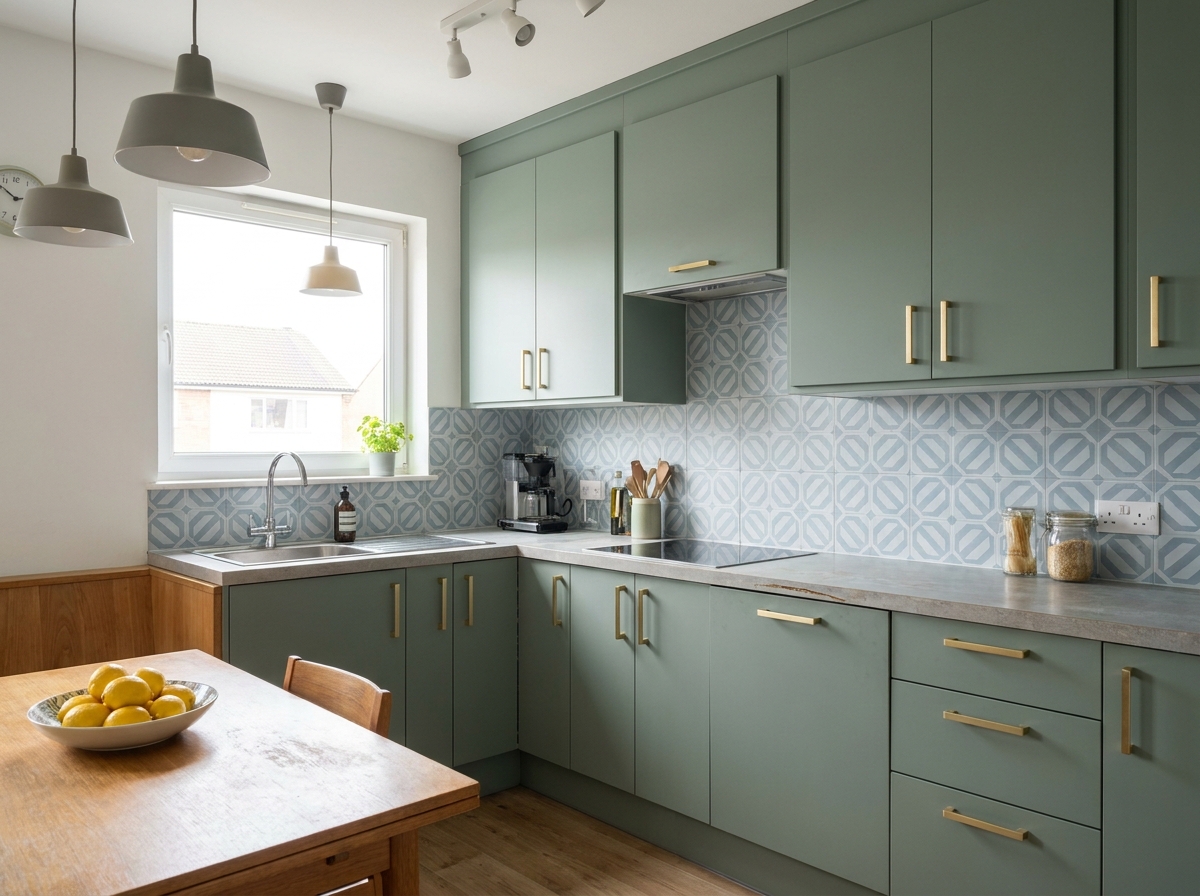
A full replacement counter runs $1,200 to $3,500 plus $400 to $600 in installation, and opens a plumbing and electrical can of worms if the new depth or cutouts do not match the old ones. Two resurfacing routes avoid that mess entirely.
Two-part epoxy resurface — looks new from 3 feet away
A two-part epoxy resurfacing kit (Giani Countertop Paint, Rust-Oleum Countertop Transformations, Stone Coat Countertops) goes directly over sanded laminate for a concrete, terrazzo, or white-marble finish. Count on $75 to $100 for 25 square feet, food-safe after 48 hours of cure, and a seven-to-ten-year life span if you avoid cutting on the surface and use trivets for hot pans. It is the cheapest path to a "new kitchen" read and the gateway fix in every small kitchen makeover I have seen.
New laminate laid over the old counter — $1,400 total
If the existing counter is ugly on top but solid underneath, a stone-look or butcher-block laminate (Wilsonart, Formica HD) can be scribed and glued right on top with contact cement. Count on $45 per linear foot in mid-grade laminate, $80 to $120 in compact HPL. Total tier-3 budget: $1,600 including tiers 1 and 2.
Tier $3,300 — Replace just the cabinet fronts
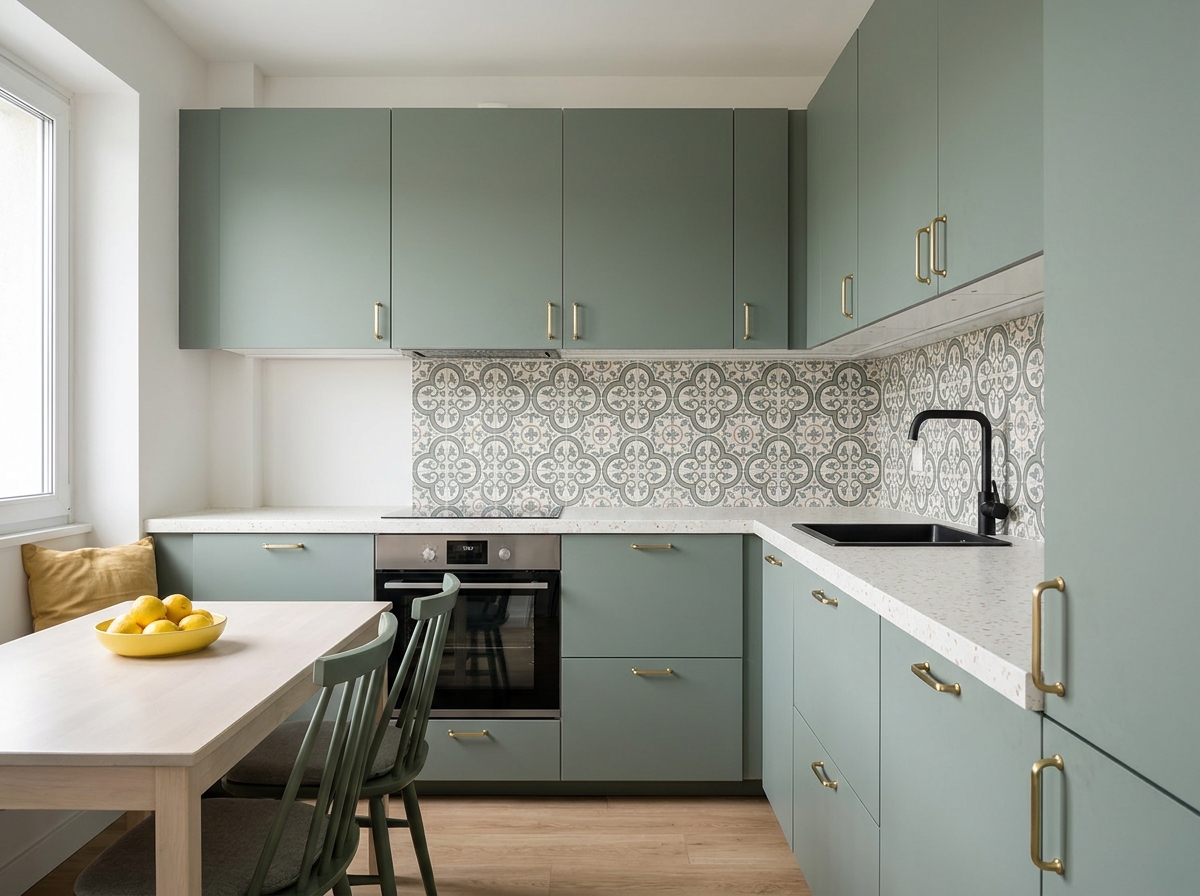
Keep the cabinet boxes, replace only the doors and drawer fronts. This is the IKEA Sektion / Metod refacing playbook, and the third-party door suppliers who built around it. It saves about 60 percent of a new-kitchen budget because cabinet boxes represent roughly 40 percent of what you pay for and 0 percent of what anyone sees once the doors are shut.
Three refacing paths that actually work in 2026
First, IKEA Sektion fronts directly, if your existing boxes are Sektion spec. Second, third-party fronts built to Sektion spec (Semihandmade, Reform, Plum Living) in shaker, slab, or reeded styles. Third, a local cabinet shop building custom doors in poplar, white oak, or MDF with laminate or 2-pack lacquer — $120 to $280 per door. For a ten-door kitchen expect $1,750 for ten replacement fronts in decent quality mid-grade, plus $200 to $400 for matching soft-close hinges if yours are worn.
Why this tier is worth testing on your room first
This is where a kitchen makeover stops feeling like a refresh and starts reading as a new kitchen. Matte fronts, thinner door profiles (16 to 18 mm), integrated handles or finger pulls, soft-close everywhere. Users who reach this tier on Homeify test 8 to 12 finishes before they buy — when the price difference between two door colors is $600 at this tier, a 30-second digital preview on your actual room earns its keep versus a Saturday at the showroom.
What does a kitchen makeover actually cost in 2026?
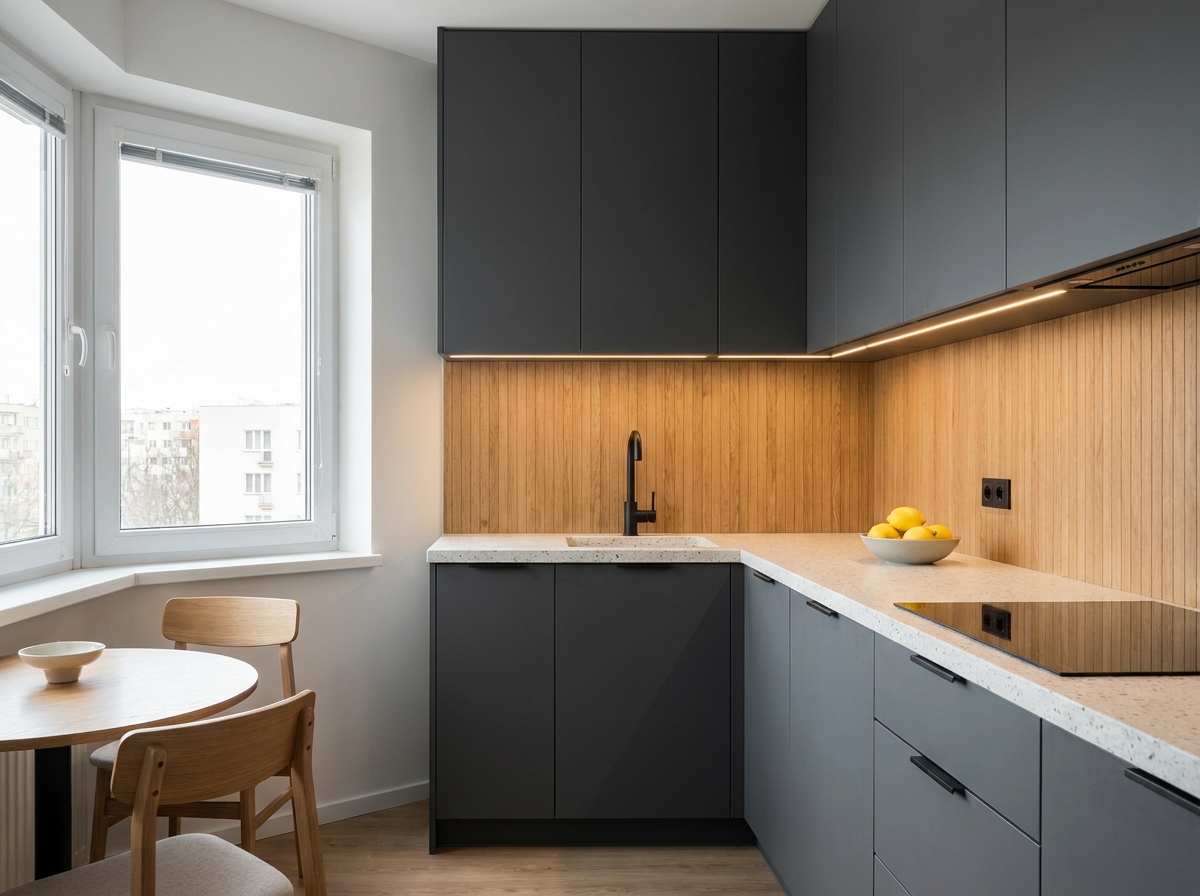
The budget splits cleanly by tier. Numbers below are 2026 US supply costs for a DIY homeowner, no contractor labor rolled in, and have held roughly stable for three years — paint and laminate track inflation lower than lumber does.
| Tier | Total budget | Timeline | Visual impact |
|---|---|---|---|
| Tier 1 — Paint cabinet fronts | $90 to $120 | 1 weekend | +50% |
| Tier 2 — + Hardware + peel-stick backsplash | $440 to $650 | 2 weekends | +70% |
| Tier 3 — + Epoxy-resurfaced counter | $1,300 to $1,700 | 3 weekends | +80% |
| Tier 4 — + Replacement cabinet fronts | $3,000 to $3,700 | 4 weekends | +95% |
| Reference — Full kitchen remodel | $12,000 to $35,000 | 3 to 6 weeks | +100% |
The honest way to read the table: through tier 3 ($1,600) you capture 80 percent of the visual impact for under 20 percent of the price of a full remodel. That is the most profitable stopping point if your kitchen is already functional. Tier 4 only pays off if the existing doors are so beaten up that paint will not hold, or the door style is so dated the refresh cannot carry it alone. The room-by-room budget makeover guide applies the same tier logic to living rooms, bedrooms, and bathrooms.
Small kitchen makeover ideas: dated oak, yellowed laminate, galley layouts
The small kitchen — galley, apartment, condo — is where the budget-tier approach earns the most. There is less surface to paint, fewer pulls to buy, fewer square feet of counter to resurface, and the visual gain per dollar is outsized. Three sub-cases show up constantly in small kitchen makeover ideas searches in 2026: dated solid-oak fronts, yellowed white laminate, and a rental kitchen where nothing can be permanently altered.
Solid oak cabinets: three options before you paint
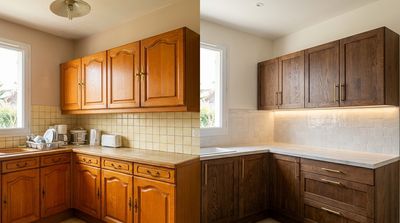
Dated oak is not automatically a problem to paint over — the grain has value a coat of matte paint can permanently erase. Three paint-free moves first: a toned wood stain (Varathane Weathered Oak or General Finishes Java Gel Stain) that darkens without hiding the grain, a whitewash or cerused finish that preserves the texture but resets the tone, or a peel-and-stick wood-grain film (d-c-fix Black Walnut) that comes off when you move out. If you still want the painted look afterward, see our dedicated guide on oak kitchen makeovers without painting for side-by-side results.
Yellowed white laminate: resurface, don't just repaint
Yellowed white cabinets are PVC oxidizing under UV, not dirt. Cleaning with oxygen bleach paste for 20 minutes can lift the tone by one or two shades, but past that only a counter resurfacing resin or an oil-bonding primer followed by cabinet enamel will cover it permanently. Do not skip the shellac primer on laminate — nothing adheres to thermofoil or melamine without it, and every single "my cabinet paint peeled" post on Reddit traces back to that one missed step.
Should you makeover a kitchen before selling the house?
Yes, but stop at tier 2. An older but clean kitchen drags home value by only 1 to 3 percent per NAR and Zillow listing-photo research — a $550 makeover is plenty for listing photos. Spending $3,300 to sell is usually a net loss, because the buyer projects their own kitchen onto the space once they walk in. Reserve the tier-4 budget for the home you're staying in.
Full $3,300 makeover vs. $15,000 remodel: the real math
The real question is not "makeover or remodel" — it's "what is actually wrong with my kitchen right now?" If the answer is tired cabinet fronts, an ugly backsplash, and a scratched counter, the $3,300 makeover fixes all three and gets close to a remodel's read. If the answer is a bad layout or dead storage space, no amount of paint will save it and the remodel is the only honest answer.
Full $3,300 makeover
Painted fronts + new hardware + peel-stick backsplash + resurfaced counter + replacement cabinet fronts — same footprint, same cabinet boxes.
- 4 DIY weekends of labor
- No demo, no drywall dust, no plumbing rework
- 80% of the visual impact of a new kitchen
- Money saved funds new lighting, stools, or decor
- Previewable on your photo before you spend a dollar
Full $15,000 remodel
Rip out old kitchen + new boxes + new fronts + new counter + new backsplash + professional install + re-plumbing.
- 3 to 6 weeks of contractor schedule
- Demolition dust, kitchen offline for 2+ weeks
- 100% of the visual impact (+20% over makeover)
- Marginal resale bump (~1 to 3% of home value)
- Locked in once the deposit lands — no real reverse gear
The headline math: 80 percent of the visual impact for 5 percent of the budget when comparing a tier-1 or tier-2 refresh ($550) against a $15,000 remodel. Users who preview on Homeify before buying paint avoid roughly three-quarters of post-paint regret. To carry the makeover logic into the rest of the home, see the companion gallery on furniture makeover before and after.
Frequently asked questions
How much does a kitchen makeover cost?
Between $100 and $3,300 in DIY supplies depending on the tier you stop at. Paint alone is $90 to $120. Paint plus hardware plus peel-and-stick backsplash is about $550. Adding a resurfaced counter brings you to $1,600. Replacing the cabinet fronts takes it to $3,300. Compare that to $12,000 to $35,000 for a full remodel with contractor labor.
How can I update my kitchen on a budget?
Work through the tiers without touching the cabinet boxes: paint the fronts first ($110), then pulls plus peel-and-stick backsplash (+$440), then an epoxy counter resurface (+$1,000), then replacement fronts only if needed (+$1,700). Stop at the tier your kitchen looks good at — for most kitchens that is tier 2, where $550 does 70 percent of the visual work.
What's the difference between a kitchen makeover and a remodel?
A kitchen makeover updates surfaces without changing the layout or the cabinet boxes: paint, hardware, backsplash, counter resurface, and optionally replacement doors. A kitchen remodel demolishes the existing kitchen and rebuilds it — new cabinet boxes, new counter, often a new layout, pulled permits, contractor labor. Makeovers run $100 to $3,300 DIY and finish in one to four weekends. Remodels run $12,000 to $35,000 and finish in three to six weeks.
Can I makeover a kitchen without replacing cabinets?
Yes — the entire point of tiers 1 through 3 is making over a kitchen without replacing anything. Paint, hardware, and peel-and-stick cover 70 to 80 percent of what a full remodel delivers. The cabinet boxes (the part attached to the wall) stay, and 40 percent of what you would otherwise pay for disappears with them. In rentals, all of tiers 1 through 2 are reversible in an afternoon if needed.
How do I paint kitchen cabinets?
Remove doors and drawer fronts, degrease with TSP or Krud Kutter, sand to 120 grit to break the gloss, apply a bonding primer (Zinsser B-I-N on laminate, INSL-X Cabinet Coat Primer on wood), then two to three thin coats of cabinet-grade enamel (Benjamin Moore Advance, Behr Cabinet & Trim, Rust-Oleum Cabinet Transformations). Six hours of dry time between coats, 30 days to fully cure. Total: one weekend for 10 fronts, $90 in supplies.
What are the best backsplash ideas for a kitchen makeover?
Three no-demo options. Peel-and-stick vinyl (Smart Tiles, d-c-fix) at $15 to $25 per linear foot, installed in an afternoon over clean existing tile — cement-tile, zellige white, and Carrara marble patterns lead the category. Thin stainless or oiled-wood panels on a 3 mm substrate for a more permanent custom look. Tile paint (Rust-Oleum TileTransformations) to preserve the relief but reset the color. Peel-and-stick is the most reversible route, which matters for renters.
How long does a kitchen makeover take?
A tier-1 paint-only makeover takes one weekend for ten cabinet fronts — Friday night to remove doors and prep, Saturday to prime and sand, Sunday for two coats of enamel. Each additional tier adds one weekend: tier 2 adds the backsplash and pulls, tier 3 adds a day for counter resurfacing cure time, tier 4 adds another for replacement door installation. A full four-tier makeover is four weekends over two to three weeks, depending on cure schedules.
How do I test 10 looks on my kitchen before I spend?
Upload a photo of your current kitchen into Homeify on iPhone. Test 10 finishes (sage green, matte charcoal, deep teal, warm off-white, light oak with brass hardware…) on your exact room — same angle, same lighting, same appliances. Each preview takes under a minute. You skip the 25 percent error margin we see on first-time makeovers done without visualization, which is where most of the "I hate it now" repaint jobs come from.
Test 10 looks on your kitchen before you spend a dollar
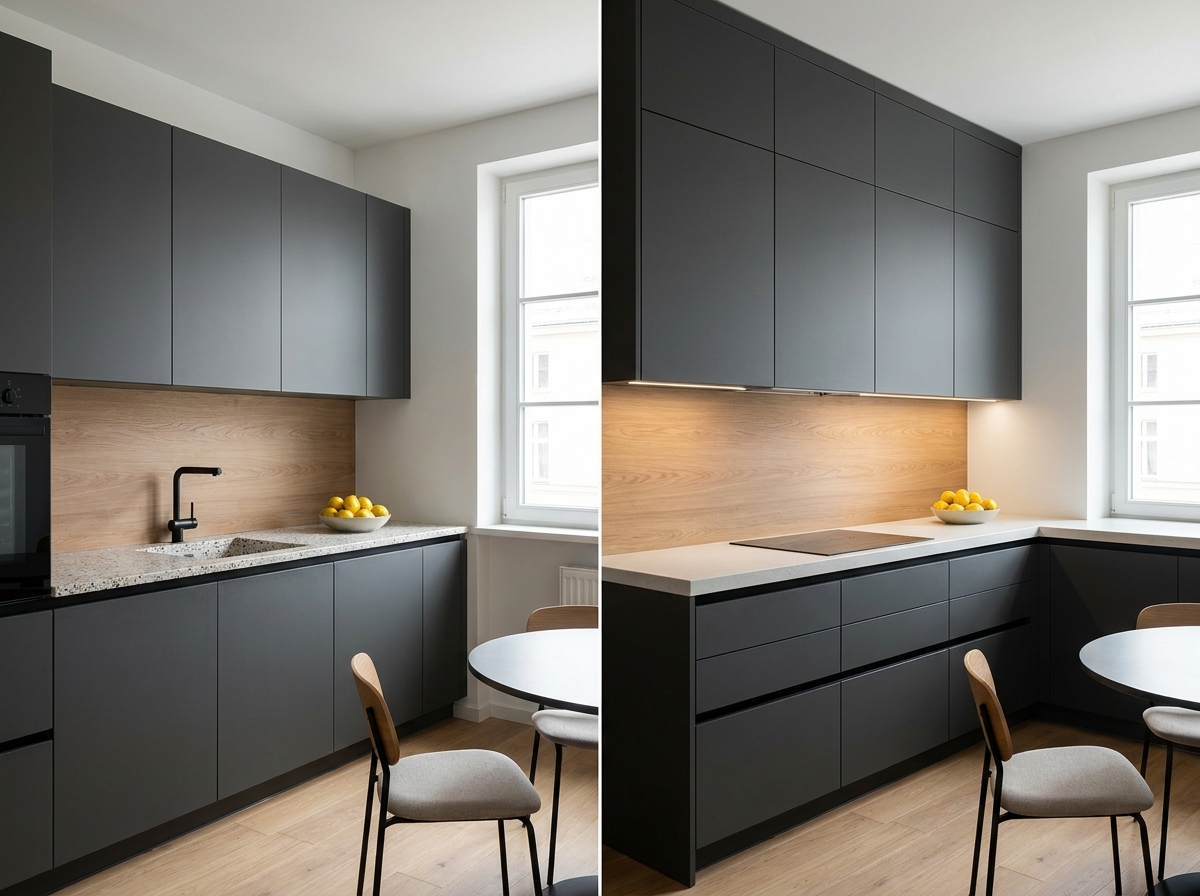
Every tier you just saw was generated on the same base kitchen — the only honest way to compare what a budget actually buys. Before you pick up that $75 can of cabinet paint, install Homeify on iPhone, shoot a photo of your kitchen, and preview 10 looks — sage green, matte charcoal, deep teal, off-white, light oak, brass hardware. You'll know which one to grab Saturday morning at Home Depot, and the $75 that would have ended up in a garage shelf stays in your pocket.
Related Articles
Was this article helpful?
Download Homeify Free
Transform any room with AI — download Homeify and start redesigning your home for free. The AI room design app trusted by thousands on iOS.
