
Antique Dresser Makeover: Keep, Flip, or Sell (2026)
Antique dresser makeover in 2026: 5 heritage pieces rendered in 4 futures each, a keep/flip/sell decision framework, and how to modernize without killing resale value.
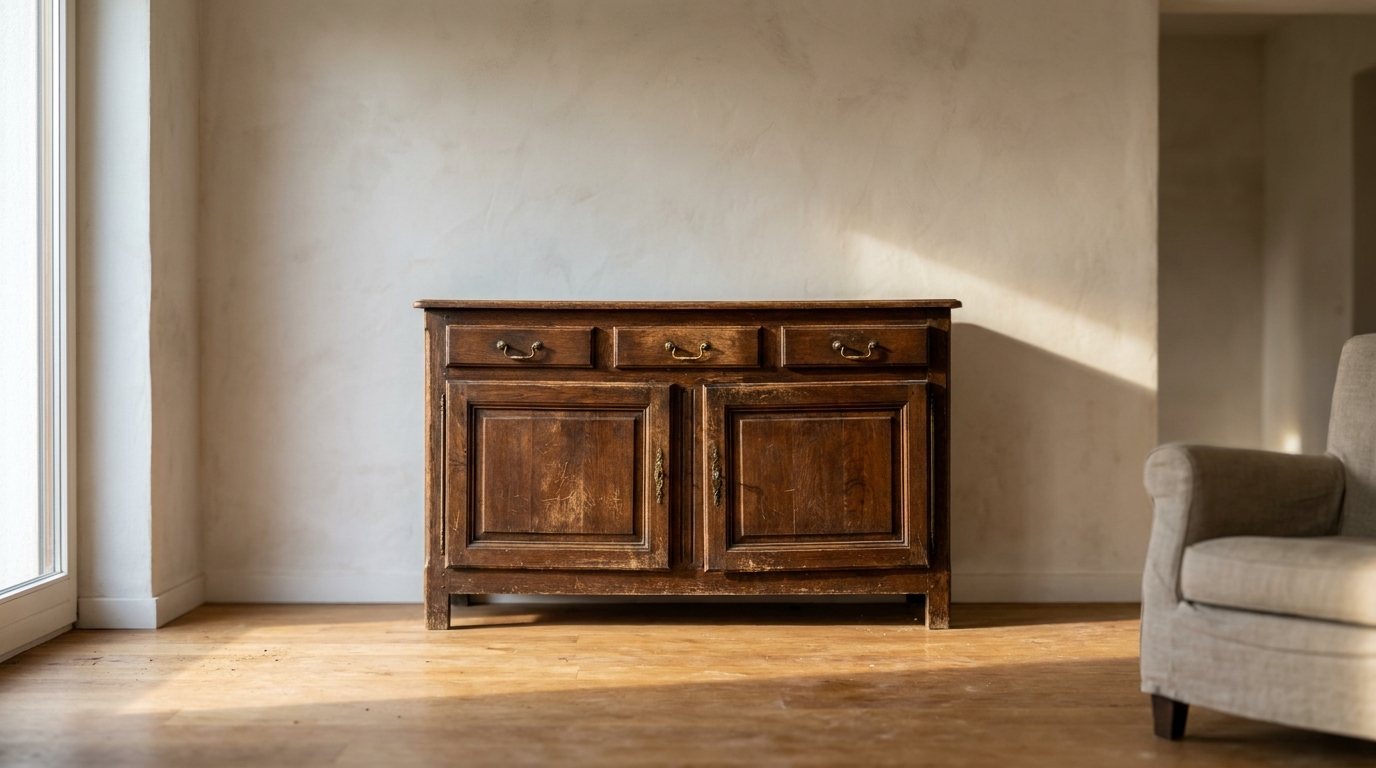
An antique dresser makeover in 2026 starts with a decision, not a brush. Before you sand a single inch of your grandmother's mahogany chest or the $80 estate-sale lowboy in your garage, answer three questions: does it carry real market value, does it hold emotional weight, and does it physically fit the room you actually live in. The three answers route you to one of three outcomes — keep with a conservation wax, flip with modern paint and hardware, or sell cleanly through a specialist. And in 2026 you can see all four futures on your own piece first. Drop a photo into Homeify and preview conservation wax, Scandi off-white, modern matte black, and sell-as-is side by side before you commit a weekend.
Most antique dresser makeover guides on the US web skip the part that actually matters. They pick one piece, one paint, one finish, and call it a tutorial. The real question — should you paint this dresser at all, or will you regret it in six months — gets left to Reddit threads and Antiques Roadshow reruns. According to the Smithsonian's Museum Conservation Institute, aggressive stripping and painting of an antique signed piece can cut 30 to 60 percent of auction value in a single weekend. The good news: on a 1970s mass-market piece or an unsigned oak lowboy, you have free rein.
This guide does two things no single-piece blog post does. It walks you through a 3-question framework to decide keep vs flip vs sell before any tool touches wood, then runs 5 inherited archetypes — dark-oak chest, 1920s walnut Art Deco waterfall, farmhouse trestle table, 1930s drop-front secretary, Pennsylvania Dutch hutch — through 4 futures each. Same base piece, same lighting, four decisions visualized. If you want the broader process and 20 more side-by-sides, our before and after old furniture makeover hub is the companion piece.
Keep, Flip, or Sell? The 3-Question Framework Before You Sand
Before a single quart of paint, a single sheet of 220-grit, a single drive to Home Depot: answer three questions. Each takes five minutes. Each routes to one of three clean outcomes — keep with a conservation shellac stick-and-touch-up, flip with a modern paint-plus-hardware treatment, or sell through a local auction house or estate liquidator. No wrong answer. A decisive answer beats a year of garage limbo.
Is It Actually Worth Something? Makers, Marks, Joinery
Flip the dresser over, pull out the top drawer, shine a phone light at the back of the carcass and at the drawer sides. You are looking for three things: a maker's mark (stamped, burned, or pencil-signed — Stickley, Berkey & Gay, Kittinger, Herman Miller), a dovetail cut by hand before 1890 (irregular spacing, thin pins, saw marks), and mortise-and-tenon joinery pegged with wood rather than screws. Any one of the three bumps a piece into the expertise-required bucket.
Kovels, the US antiques price guide of record since 1953, lists signed Stickley and Kittinger case pieces regularly between $800 and $4,500. Painting one with chalk paint converts it into a $150 Facebook Marketplace listing. The rule is simple: if you find a signature or an 1800s date range, get a free photo appraisal from a local auction house or Heritage Auctions before the first drop cloth goes down. Unsigned mid-century factory pieces from the 1960s to 1990s? Go ahead and flip.
Does It Carry Emotional Weight You Can't Replace?
The better question isn't "do I love it." It's: would I buy this piece at an estate sale tomorrow, with zero family history attached, for the asking price? If the answer is no, you are carrying it on emotional weight alone — and that's where a careful flip earns its keep. Painting grandma's dresser in a Benjamin Moore Simply White or a Sherwin Williams Iron Ore doesn't erase grandma. It passes the dresser forward one more generation, in a color you actually want to see every morning. If the emotional weight is genuinely zero — the $40 Craigslist pickup from a Sunday drive — treat it as a pure creative project with no preservation guardrails.
Does It Physically Fit the Room You Live In?
Measure before you paint. A Pennsylvania Dutch hutch at 78 inches tall swallows a 400-square-foot studio even in white chalk paint. An antique dresser with mirror at 84 inches total height needs 36 inches of wall space just for the mirror reveal. If the piece physically can't land in the room you live in today, and you don't have a realistic move planned in the next two years, the mature outcome is a listing on Chairish, 1stDibs Vintage, or a local estate-sale service. Selling is not failure. Six months of garage storage is.
If budget is the constraint rather than space, our budget room makeover guide walks through cost trade-offs for redoing a bedroom around an antique piece you've decided to keep.
5 Inherited Pieces, 4 Futures Each — A Gallery
Five heritage archetypes — the ones that actually land in American garages and basements — rendered in 4 futures side by side: original conserved, Scandi off-white, modern matte black, and sold-as-is. Same base piece each time, so you're comparing apples to apples instead of stitching Pinterest thumbnails from strangers' bedrooms.
Dark-oak inherited dresser — 4 futures
Six-drawer oak chest in a tobacco-stained finish, oxidized brass pulls, probably 1940s-1960s American factory. Keep-conserved: strip the old wax with mineral spirits, one coat shellac sanding sealer, two coats Briwax clear, about three hours. Scandi flip: Benjamin Moore Simply White OC-117 or Sherwin Williams Alabaster SW 7008 in two eggshell coats, swap to leather loop pulls. Modern flip: Behr Ultra Pure Black in matte, long 6-inch brass bar pulls. Sell: a clean oak dresser like this lists at $150-$275 on Facebook Marketplace without any work.
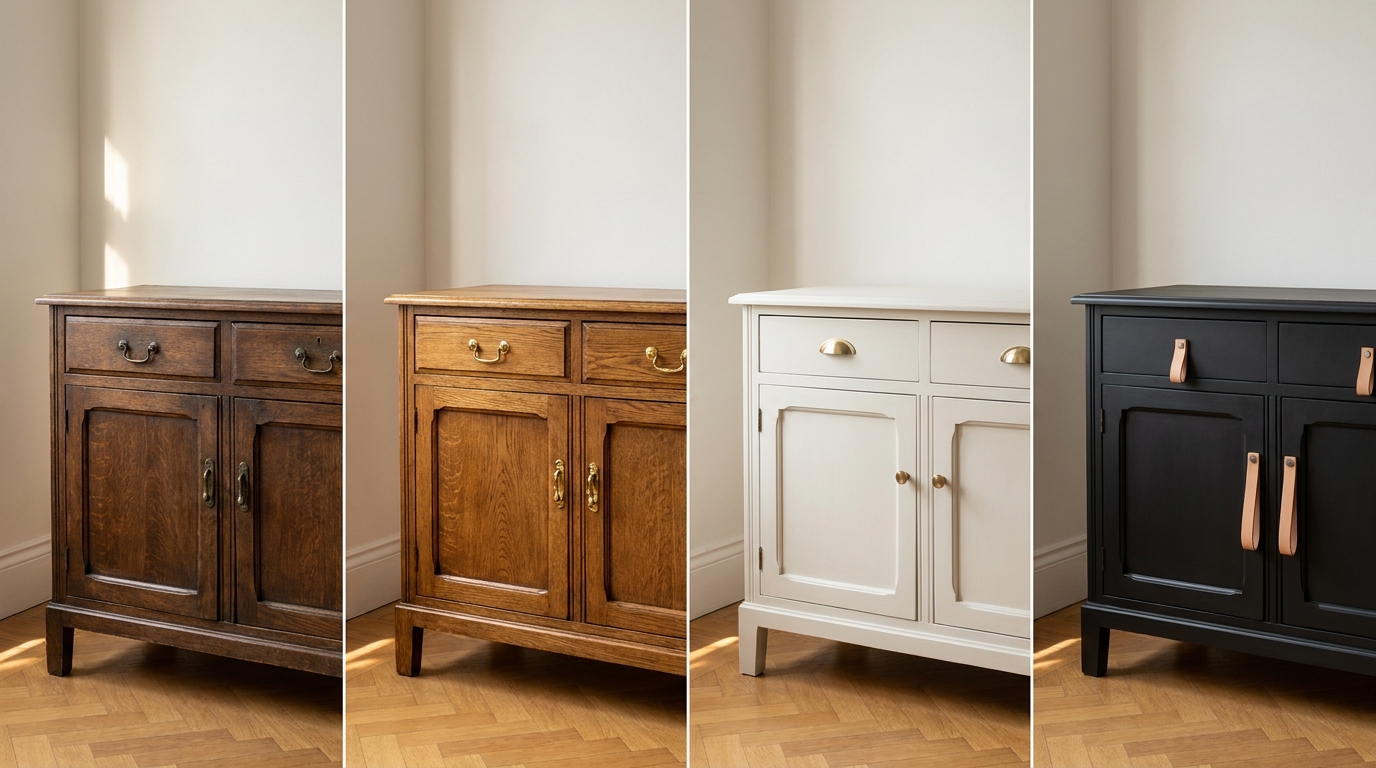
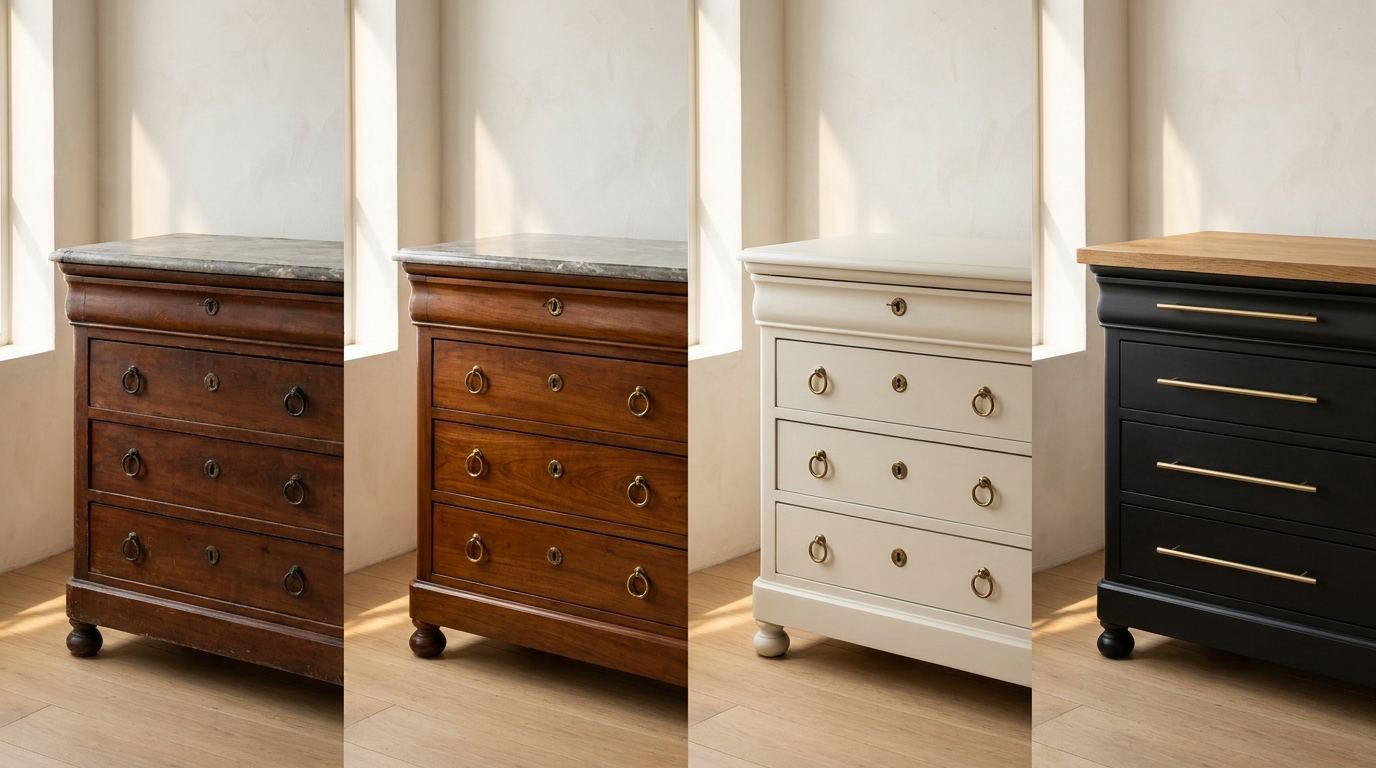
1920s walnut Art Deco waterfall dresser — 4 futures
Four or five drawers, signature curved waterfall top, walnut veneer over poplar secondary wood. The veneer is the landmine. A Smithsonian MCI note on veneered case goods warns that machine sanding removes veneer in under 10 seconds — hand-sand at 180-240 grit only, and never through the grain. Keep-conserved: gentle cleaning with a 50/50 dish-soap-and-water wipe, one coat of Howard Restor-A-Finish in walnut. Scandi flip: don't paint the veneer — instead swap original Bakelite pulls for oil-rubbed bronze or unlacquered brass in the same bolt-hole pattern. Modern flip: repaint only the side panels in matte charcoal and leave the waterfall top as is. Sell: good condition 1920s-30s waterfall dressers move for $300-$650 in US Midwest auctions.
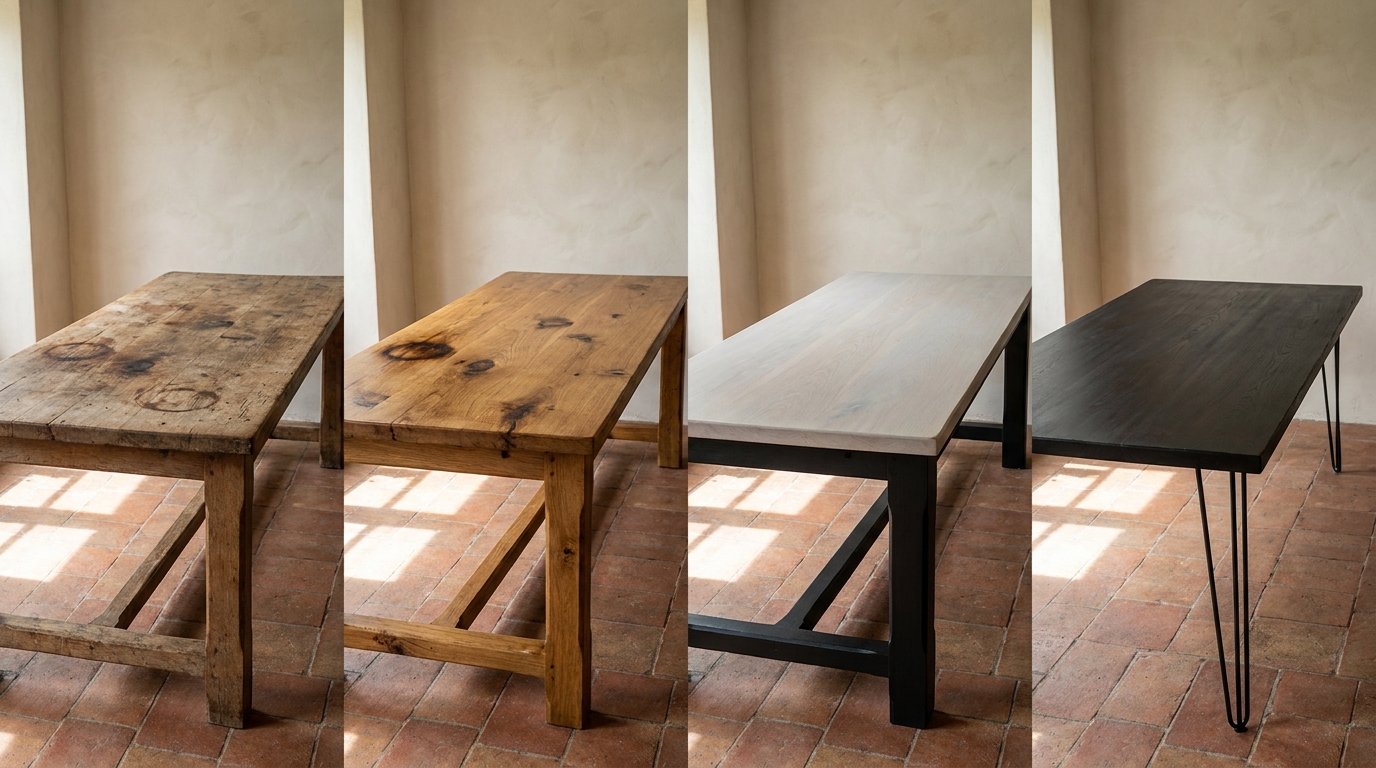
Farmhouse trestle table — 4 futures
Solid oak plank top, 72 by 36 inches, trestle base, scarred by a century of dinners. Keep-conserved: sand 120 then 220, three coats of hard-wax oil (Rubio Monocoat Pure or Osmo Polyx 3032) — the knife marks read as history, not damage. Per the Osmo technical data sheet, a properly applied oil finish on solid hardwood delivers 20-30 years of service before a refresh is needed. Scandi flip: white-washed top (chalk paint diluted 1:3 with water) with the base painted Benjamin Moore Wrought Iron 2124-10. Modern flip: top refinished with Minwax Dark Walnut gel stain, base in Behr Pure Black matte steel effect. Sell: 19th-century oak trestles are the rare case where selling feels like sacrilege — they outlast everything.
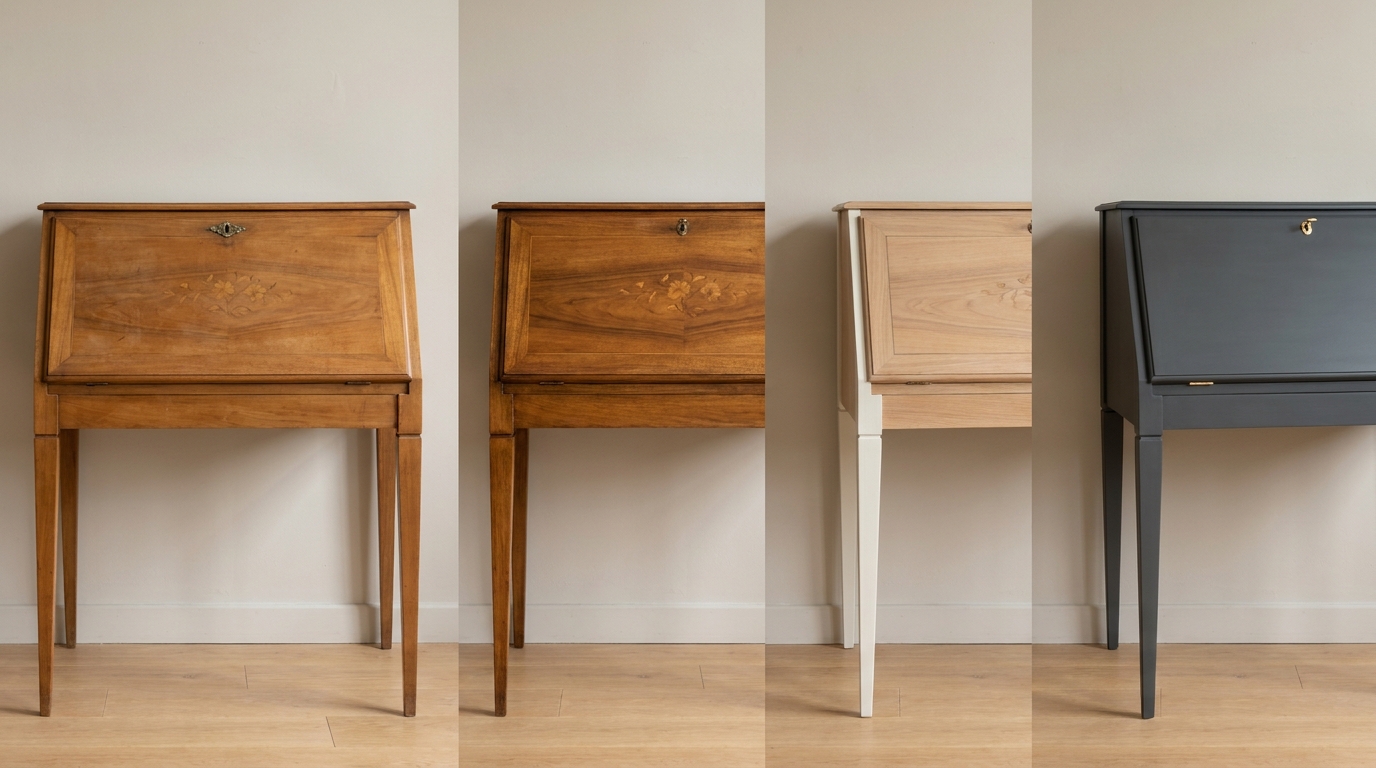
1930s drop-front secretary desk — 4 futures
Drop-front flap, interior pigeonholes, walnut or mahogany veneer, common 1930s-1940s factory piece across the Northeast. The veneer rules again: hand-sand only, 220 grit, with the grain. Keep-conserved: shellac and paste wax, restore interior pigeonhole inlay with a no-sand scuff primer only if the original finish is already peeling. Scandi flip: paint only the exterior sides and top in Benjamin Moore White Dove OC-17, leave the drop-front flap natural — creates a two-tone that still reads vintage. Modern flip: Sherwin Williams Tricorn Black SW 6258 in satin with brushed-brass library pulls, pigeonhole interior painted in a contrast color like Behr Blueprint S470-5. Sell: $200-$425 at regional auction houses, more for Kittinger or Governor Winthrop signed examples.
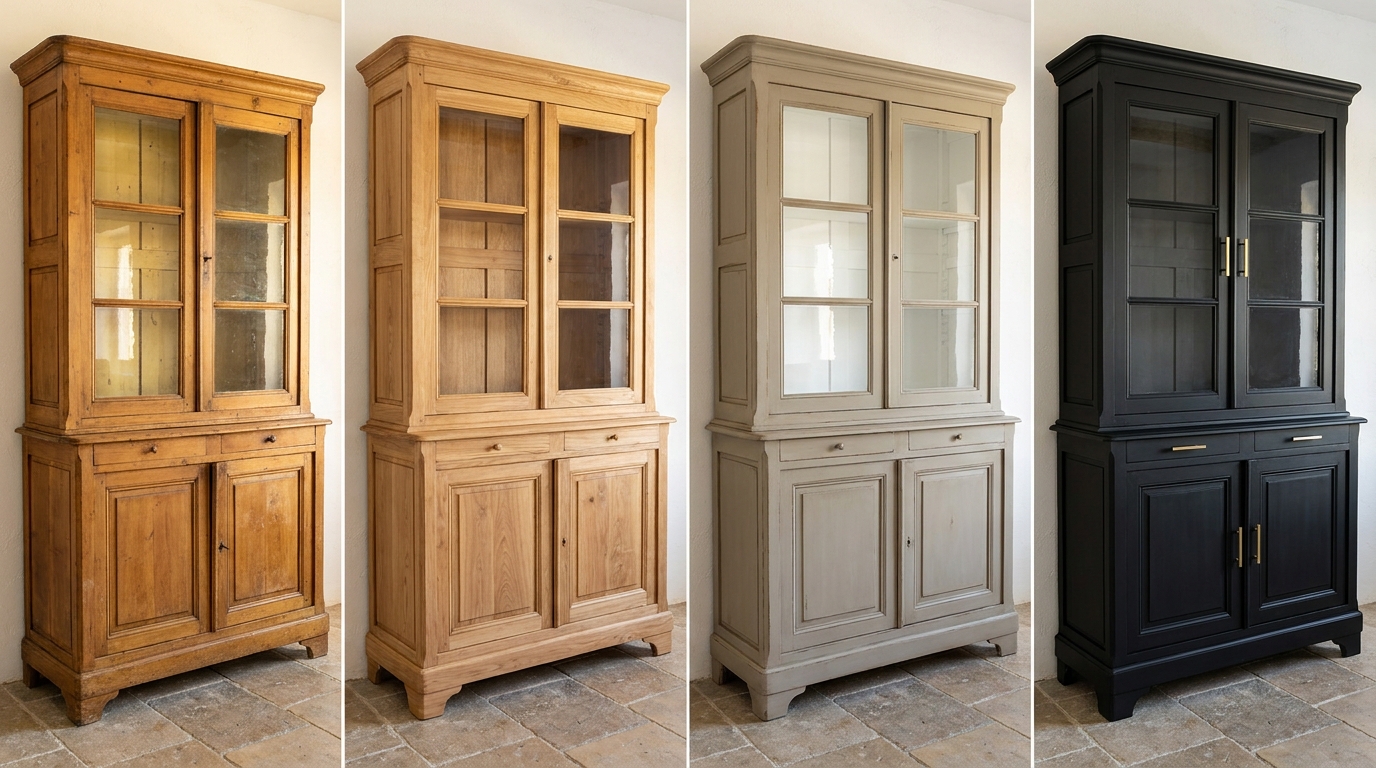
Pennsylvania Dutch hutch — 4 futures
The tallest piece on the list, 72-78 inches, glazed upper doors, two solid lower doors. Keep-conserved: citrus-based stripper on the exterior only, clear wax, glass cleaned with 50/50 vinegar. Scandi flip: greige body (Farrow & Ball Hardwick White) with the glazed-cabinet interior in pure white. Modern flip: matte charcoal throughout with unlacquered brass pulls, reads as architectural presence in an open-plan kitchen. Sell: if your ceilings are 8 feet, a 78-inch hutch is fighting the room — list it on Chairish and move on.
How to Modernize Antique Furniture Without Killing Its Value
Three techniques cover 90 percent of modernizations that a future buyer can still reverse — which is the whole game if you want the option to sell in 10 years without eating a loss:
- Hardware swap only — save every original pull in a labeled Ziploc bag, install modern replacements in the same bolt-hole pattern. Oil-rubbed bronze, unlacquered brass, or black matte bar pulls. Fully reversible, single-afternoon project, zero impact on wood or original finish.
- Chalk paint plus clear wax (Annie Sloan, Behr Chalk Decorative) — two thin coats over the existing finish without stripping, sealed with clear wax. Removable later with mineral spirits plus a light 180-grit pass, original wood comes back. The trap: chalk paint on a signed Stickley or Hitchcock chair is a value killer. See the FAQ for how to tell.
- Gel stain over the existing finish (General Finishes Java Gel, Minwax Express Color) — wipes on, wipes off, takes an afternoon, darkens the whole dresser by two to three shades without stripping. The most invisible change and the most reversible: another coat of stripper puts you back where you started.
The irreversible moves — full strip-and-stain to a radically different color, machine sanding through veneer, replacing original locks with modern ones, sawing off an original leg to "update" the profile — are where resale value evaporates. PBS Antiques Roadshow appraisers note these decisions in almost every segment where a refinished piece gets appraised at a fraction of what a conserved sibling would.
Antique Dresser with Mirror Makeover: Three Paths That Work
A mirrored dresser is a design problem disguised as a paint problem. The mirror is usually the dated element, not the wood. Three paths actually deliver a modern read:
Path 1: Remove the mirror and re-frame it as art
Unscrew the mirror posts, store the hardware, hang the mirror alone on a different wall in a new frame (Framebridge does custom antique-mirror reframes starting around $140). The dresser reads as a standalone modern piece; the mirror becomes intentional wall art instead of inherited luggage. Lowest effort, highest impact, fully reversible.
Path 2: Paint the mirror frame only
Leave the dresser body in its original finish; paint just the mirror posts and frame in a matte black (Rust-Oleum 2x Ultra Cover Satin Black) or a warm off-white. Creates a deliberate two-tone read, ties into 2026's modern-vintage trend, and if you hate it the frame sands back in an hour.
Path 3: Replace the mirror glass with smoked or antiqued
Any local glass shop will cut a smoked, bronzed, or artificially aged mirror to spec for $80-$180. Keeps the silhouette, modernizes the reflection. Particularly strong on 1920s walnut Art Deco waterfall pieces where the original silvering is already splotched from age.
DIY Antique Dresser Makeover: Paints, Waxes, and Finishes That Last
For a DIY antique dresser makeover that survives more than two moves, match the product to the intent. Chalk paint is forgiving, which is why every beginner Pinterest tutorial starts there — but chalk paint devalues an antique signed piece even when sealed with clear wax, because resale buyers read it as an amateur flip. For a modern painted look on unsigned factory pieces, Benjamin Moore Advance or Sherwin Williams Emerald Urethane Trim Enamel levels smoother than chalk paint, cures harder, needs no wax topcoat, and cleans with a damp rag. Two thin coats with an Allpro Symphony brush or a foam roller, 4-hour cure between coats.
For a keep-natural antique dresser, a fresh coat of gel stain over the existing finish (General Finishes Java Gel, Minwax Gel Stain in Walnut) wipes on with a rag, wipes off with a second rag, and restores depth without stripping. Follow with a wipe-on polyurethane for protection. Per Minwax product specifications, a gel-stain-plus-wipe-on-poly system delivers 20 to 30 years of service life on interior case goods, about the same as the original factory finish you're preserving.
For a two-tone body, lay down a clean bead of 2-mil painter's tape (FrogTape Delicate Surface, yellow — never standard blue on freshly painted surfaces). Burnish the edge with a credit card, paint the second color in two thin coats, and pull the tape while the final coat is still slightly tacky. Waiting for a full cure before removal is how you end up with jagged edges that require a third pass.
| Future | Supplies Budget | Weekend Hours | Reversible? |
|---|---|---|---|
| Keep conserved (shellac + wax) | $35-$65 | 3-4 hours | Fully |
| Scandi off-white + new pulls | $85-$140 | 6-8 hours | Yes, with stripper |
| Modern matte black + brass | $95-$160 | 7-10 hours | Yes, with stripper |
| Sell as is (Chairish, 1stDibs, estate) | $0-$25 (listing fees) | 1-2 hours of photos | N/A |
Frequently Asked Questions
How do I restore an antique dresser?
Start with a gentle clean — 50/50 dish soap and water on a microfiber cloth, dried immediately. If the original finish is intact, refresh with Howard Restor-A-Finish in the matching wood tone and follow with paste wax. If the finish is flaking, use a citrus-based stripper (Citri-Strip) rather than methylene chloride, which the EPA has restricted for consumer use. Hand-sand only on veneered surfaces (220 grit, with the grain), and keep all original hardware in labeled bags.
Is it worth restoring antique furniture?
Yes — when the piece shows signed joinery, a recognizable maker's mark, or pre-1890 hand-cut dovetails. A professional conservator (find one through the American Institute for Conservation's Find-a-Conservator directory) will charge $300-$900 to restore a mid-sized dresser, and the resale lift on a signed Stickley or Berkey & Gay piece typically covers the cost two or three times over. For unsigned 1970s factory pieces with no documented provenance, restoration rarely pencils out — a sympathetic flip delivers more per-hour satisfaction.
What paint is best for antique furniture?
For an unsigned flip piece where the painted look is the goal, water-based urethane trim enamel (Benjamin Moore Advance, Sherwin Williams Emerald Urethane) levels smoother and cures harder than chalk paint, and needs no wax topcoat. For a softer vintage read, chalk paint (Annie Sloan, Rust-Oleum Chalked, Behr Chalk Decorative) adheres without primer on most old varnishes. In both cases, two thin coats beat one heavy one, and the cleanup rule is: degrease with TSP or a 50/50 vinegar solution before anything else, or the finish lifts the first time water touches it.
Should you refinish or paint an antique dresser?
Refinish when the piece is signed, pre-1900, or has visible hand-cut dovetails — stripping and staining preserves the wood grain and the value. Paint when the piece is unsigned, mass-produced after 1940, and you want it to fit a modern palette. The gray zone between the two — 1920s-1940s factory furniture — usually rewards a middle path: original exterior kept with gel stain, interior drawers painted, hardware swapped.
How do you modernize antique furniture without ruining its value?
Keep every change reversible. Hardware swap with originals stored in labeled bags: fully reversible. Chalk paint plus clear wax over the existing finish: reversible with stripper. Gel stain over the existing finish: reversible. What ruins value is machine sanding through veneer, stripping original patina on a signed piece, sawing off original legs, or painting over original carved details. The Smithsonian Conservation Institute guideline is straight: the less original material you remove, the more value you preserve.
Does painting antique furniture devalue it?
For signed or pre-1890 pieces, yes — meaningfully. Kovels and PBS Antiques Roadshow appraisals consistently show painted signed antiques selling at 30-60 percent of comparable unpainted examples. For unsigned mass-market pieces after 1940, painting usually has no effect on resale value — the market treats them as furniture, not antiques, and a well-executed paint job can even lift the listing price. When in doubt, get a free photo appraisal from a regional auction house before you open a paint can.
How can I tell if my old dresser is valuable before painting it?
Four fast signals. One: pull out a drawer and look at the side construction — hand-cut dovetails (irregular, thin pins) point to pre-1890; machine-cut dovetails (uniform) to post-1890; staples or screws to post-1950. Two: look for a maker's mark on the back of the carcass, inside the top drawer, or under the top. Three: check the secondary wood (drawer sides and back) — pine or poplar suggests 1800s American; plywood suggests post-1940. Four: search the maker's name on Kovels.com or LiveAuctioneers for recent comparable sales. If the piece hits three of four signals for age, pause before painting and call a local auction house.
Test 4 Futures on Your Own Antique Dresser with Homeify
Your inherited dresser — waterfall walnut, oak lowboy, farmhouse hutch — deserves the preview before any irreversible decision. Open Homeify, upload a clear daylight photo of the actual piece, and compare conservation wax, Scandi off-white, modern matte black, and sell-as-is side by side on your own photo in under a minute. Rule out three futures, keep the one that clicks with the room, then head to the hardware store with a plan instead of a hunch. For 20 more before-and-after examples across five other piece types, pair this with the before and after old furniture makeover hub, or see 15 painted furniture ideas by style for finish-level inspiration across 5 aesthetic buckets.
Related Articles

Was this article helpful?
Download Homeify Free
Transform any room with AI — download Homeify and start redesigning your home for free. The AI room design app trusted by thousands on iOS.
