Accent Wall Behind Bed: 4 Rules + 12 Wallpaper Ideas
How high, how wide, how to align? 4 placement rules for an accent wall behind your bed + 12 wallpaper ideas tested in AI on the same bedroom.
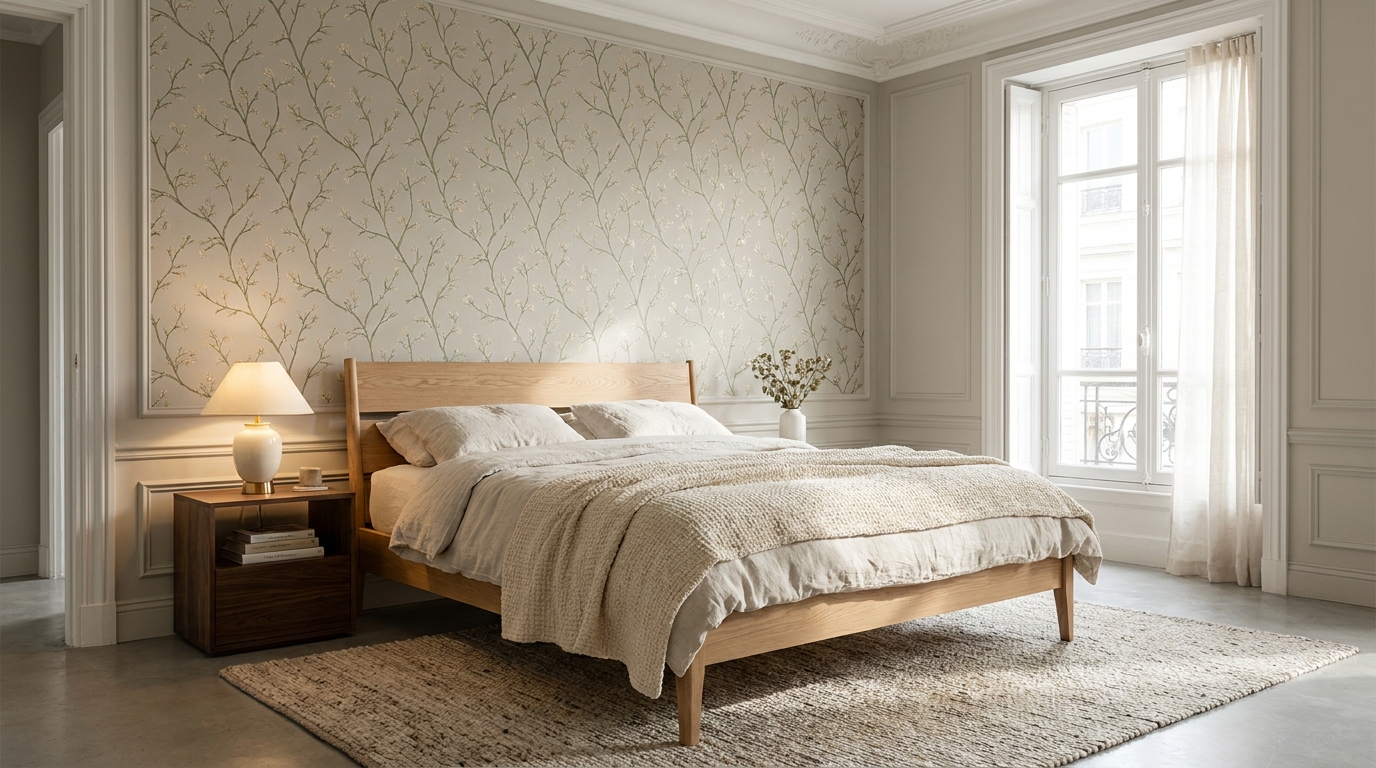
An accent wall behind the bed comes down to four placement rules — pattern height, panel width, vertical alignment, and how the wallpaper plays with the bed wood — applied before you pick the print. With Homeify, you can drop 8 wallpapers onto a photo of your real bedroom in 30 seconds before you commit to an $80 roll.
Accent Wall Behind Bed: The 4 Rules Before the Ideas
You're standing in the bedroom holding a wallpaper sample. Where exactly does it go? How high? How wide? Should it line up with the bed, or with the wall? Most inspiration shots cheat on framing — the photo crops the ceiling, the bed sits dead center, you never see where the roll actually stops. So you order, you install, and the pattern lands too low, too narrow, or shifted 12 inches off the bed. In 2026 the bedroom is the room you stare at most while doing nothing — first thing in the morning, last thing at night. A placement mistake stays visible for years.
Before the print, lock down 4 rules before 12 ideas: where the pattern stops above the bed, how wide the panel sits relative to the mattress, how the print aligns vertically with the headboard, and how the motif plays with the bed wood. These four rules eliminate roughly 80 percent of bad outcomes before you even open a swatch book. Then you scroll the 12 ideas below — each one rendered on the same baseline master bedroom so you compare wallpapers, not 12 different rooms.
Rule 1 — Height: Where to Stop the Pattern Above the Bed
This is the first thing every search returns: how high should an accent wall behind the bed go? Most installers default to ceiling-height wallpaper, but you have two valid choices. The rule that holds up nine times out of ten: the pattern needs to extend at least 30 inches / 75 cm above the physical headboard. Below that mark the wallpaper looks crushed by the bed — you see the headboard, then a thin band of pattern, then bare wall above it. Your eye stalls and the accent disappears. Above 30 inches the pattern breathes and the bed plus wall reads as a single composition.
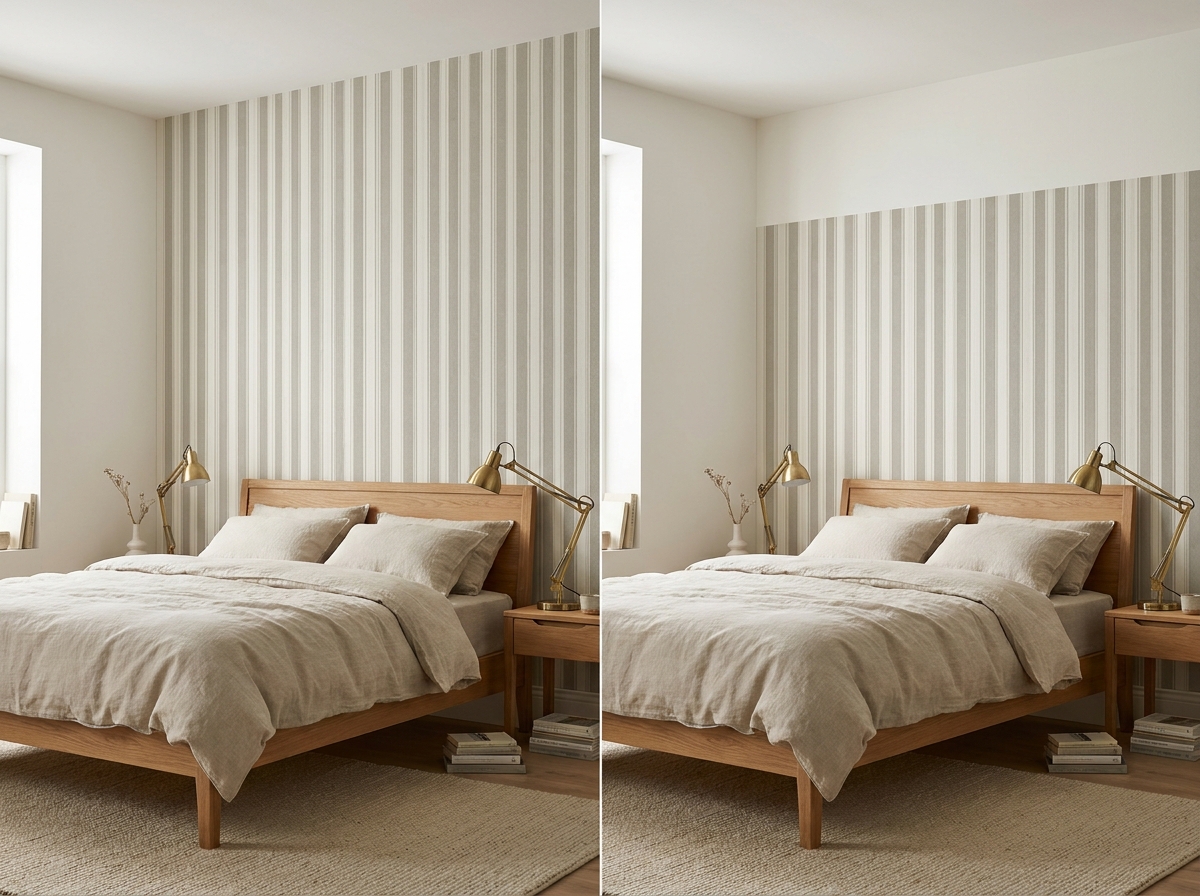
In practice you have two clean options: run the wallpaper all the way to the ceiling, which always works and gives the room a cinematic feel; or stop at door-jamb height (around 84 inches / 210 cm from the floor), which creates a high frieze and leaves a calm white band above. Anything in between — stopping at 71 inches or 77 inches — looks indecisive. Pick one or the other, never the middle.
Rule 2 — Width: A Wallpaper Headboard Is Never Narrower Than the Bed
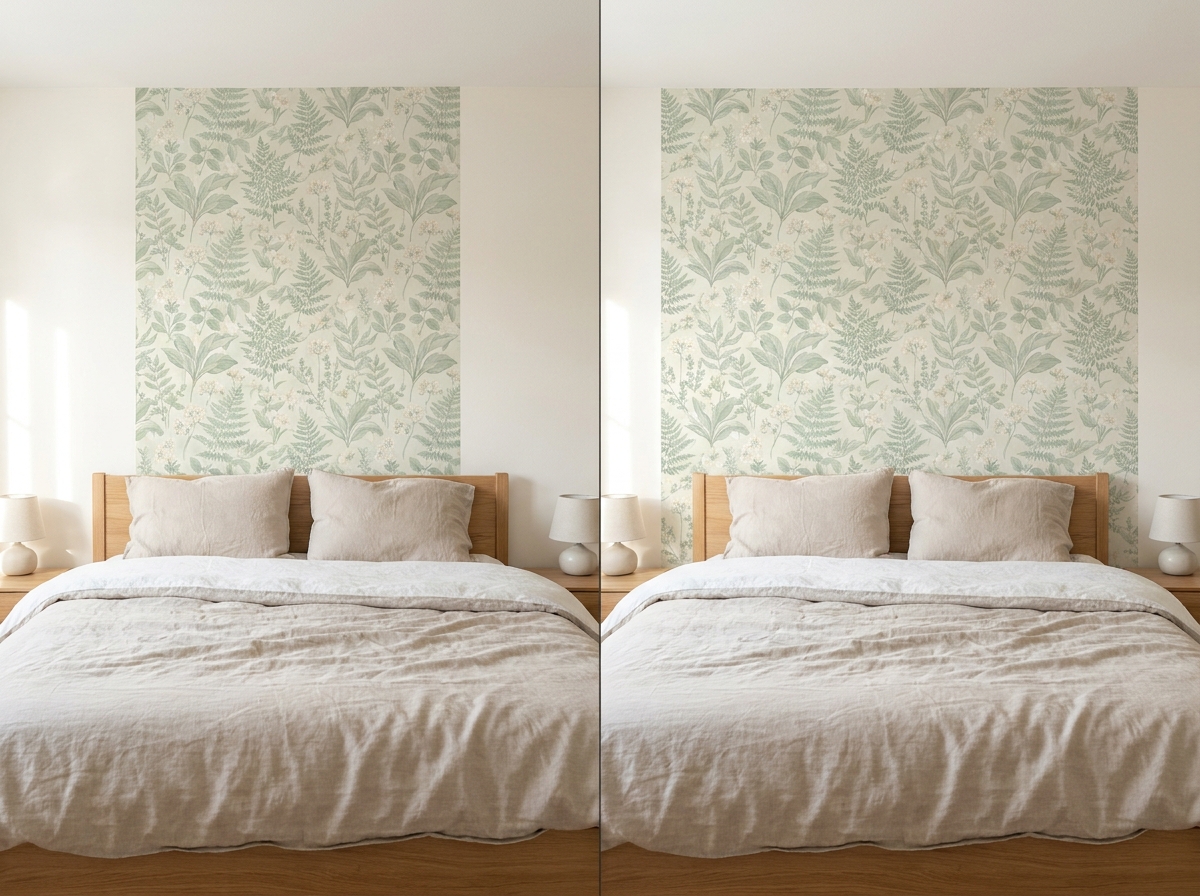
The most common mistake when you try a wallpaper headboard for the first time: ordering two rolls and pasting a panel that sits exactly the width of the bed. In the magazine shot it looks neat. In the actual bedroom the panel reads as shrunken — the mattress and pillows cover both edges, and the wallpaper looks like a poster pinned in the wrong place.
The clean rule: the wallpaper panel should run 4 to 8 inches / 10 to 20 cm wider than the bed on each side, which adds 8 to 16 inches of total width. For a queen (60 inches), shoot for an 68- to 76-inch panel. For a king (76 inches), shoot for 84 to 92 inches. Anything beyond that and you should switch to the radical option: full wall, baseboard to crown, edge to edge. Both extremes work. The in-between width — wallpaper exactly matching the bed — does not. That's the rule.
The 4-to-8-inch margin gives the pattern room to live behind the pillows and nightstands, so it stays readable when the bed is made — not just when the room is staged for a photo. This is also where the question "should the accent wall be wider or narrower than the bed?" gets its definitive answer: never narrower, always either slightly wider or full-wall.
Rule 3 — Alignment: Center the Pattern on the Bed, Not on the Wall
Almost every install guide tells you to center the pattern on the wall. That's wrong for a bedroom: the wall behind the bed is rarely a clean rectangle. There's an off-center window, a closet door, a cable outlet, a vent. The reference that matters isn't the wall — it's the bed.
The rule: pattern center aligned with bed center. Snap a vertical chalk line through the middle of the mattress, then place the visual axis of the wallpaper (the main bloom of a panoramic, the spine of a graphic, the median strip of a stripe) on that line. If the wall is wider on one side than the other, so be it — the print is off-center to the wall but locked to the bed. That's what makes the room read photographic instead of off-balance.
The rule matters most for panoramic murals (a single image stretched across 3 to 4 drops) and directional motifs (chevrons, branches, vertical florals). For repeat patterns like fine stripes or pin-dots, alignment matters less — a 2- to 4-inch shift slips by unnoticed.
Rule 4 — Pattern vs. Bed Wood: The Match That Decides Everything
This is the rule no one writes about, and it's the one that wrecks four bedrooms out of ten. The wallpaper has to dialogue with the material of the actual headboard. A 2024 Cornell University study on bedroom visual perception found that the brain reads the bed wood plus the wallpaper as a single visual unit — not as two separate elements. Pile two busy elements together and the room saturates. Pair two neutral elements and the room flattens.
The combination rule that holds up, by bed-wood color:
- Light oak, ash, or birch: busy patterns work — botanical mural, high-contrast geometric, wide stripe. The pale wood absorbs visual noise.
- Walnut, espresso, dark stained oak: stick to desaturated motifs — soft botanical, monochrome geometric, fine greige stripe. Anything brighter and the room shouts.
- White or no headboard: anything goes — the wall plays the role of headboard. That's the angle behind a great white bedroom: the wallpaper IS the headboard.
- Upholstered fabric headboard: keep the wallpaper quiet — textured solid, micro-print, fine stripe. The fabric is already adding visual texture.
The two-word version: light wood = busy pattern OK / dark wood = desaturated pattern. When you're stuck between two wallpapers, pick the one that sits furthest from the bed wood in tone — almost always the one that photographs better.
12 Accent Wall Behind Bed Ideas Tested on the Same Master Bedroom
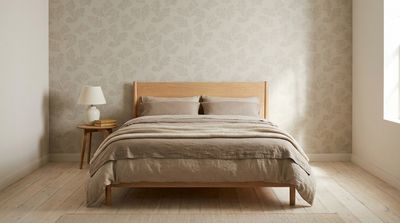
To compare 12 wallpapers honestly you have to drop them onto 12 wallpapers on one identical master bedroom: same angle, same window, same light oak bed frame, same washed-linen bedding. That's the only way you actually see what the print changes. Scroll 12 inspiration shots from the open web and you're comparing 12 different beds, 12 different ceiling heights, 12 different lights at once — you learn nothing about the wallpaper.
The 12 accent wall behind bed ideas are grouped in three buckets of four: panoramic murals (one big image), dark geometrics (graphic discipline), and stripes plus repeat micro-prints (the calm category). Every one obeys the four rules above. For the broader bedroom palette layered over these wallpapers, see the 30 bedroom wallpaper ideas parent guide.
Bucket 1 — Panoramics: 4 Master Bedroom Accent Wall Behind Bed Ideas
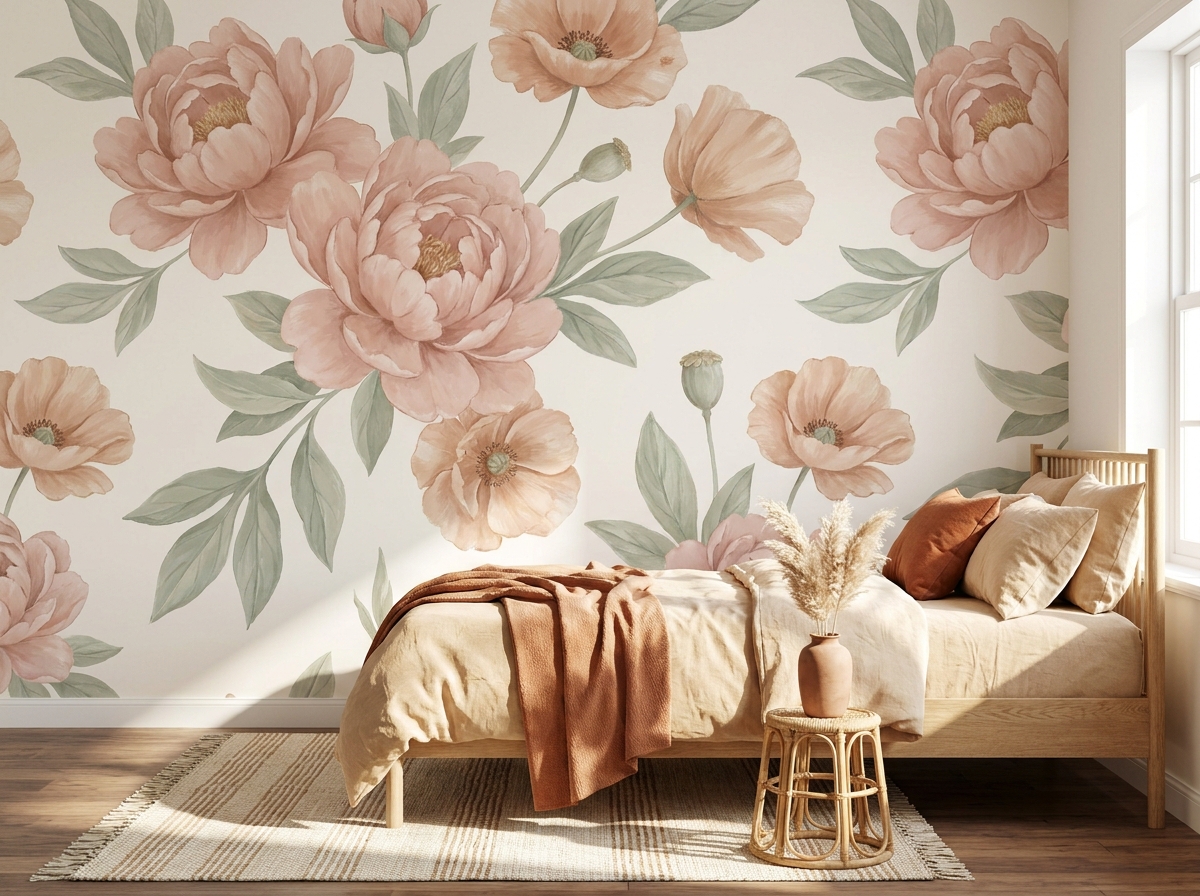
The panoramic mural, dark geometric, vertical stripe trio carries 80 percent of contemporary master bedrooms. Idea 1 is a botanical mural — overscale leaves, soft sage and chalk, ideal for a north-facing room that needs warming up. Idea 2 swaps in a Japandi mountain scene in chalk and indigo for a calmer master bedroom accent wall behind bed. Idea 3 is a dusty-pink fresco mural — quiet but never bland. Idea 4 is the heritage move: an 18th-century forest panorama in muted greens for an old-house bedroom. All four require Rule 3 (center on the bed, not the wall) — otherwise the focal flower or peak lands six inches off the headboard and the room looks unbalanced for years.
Bucket 2 — Dark Geometrics: 4 Bedroom Accent Wall Behind Bed Ideas with Edge
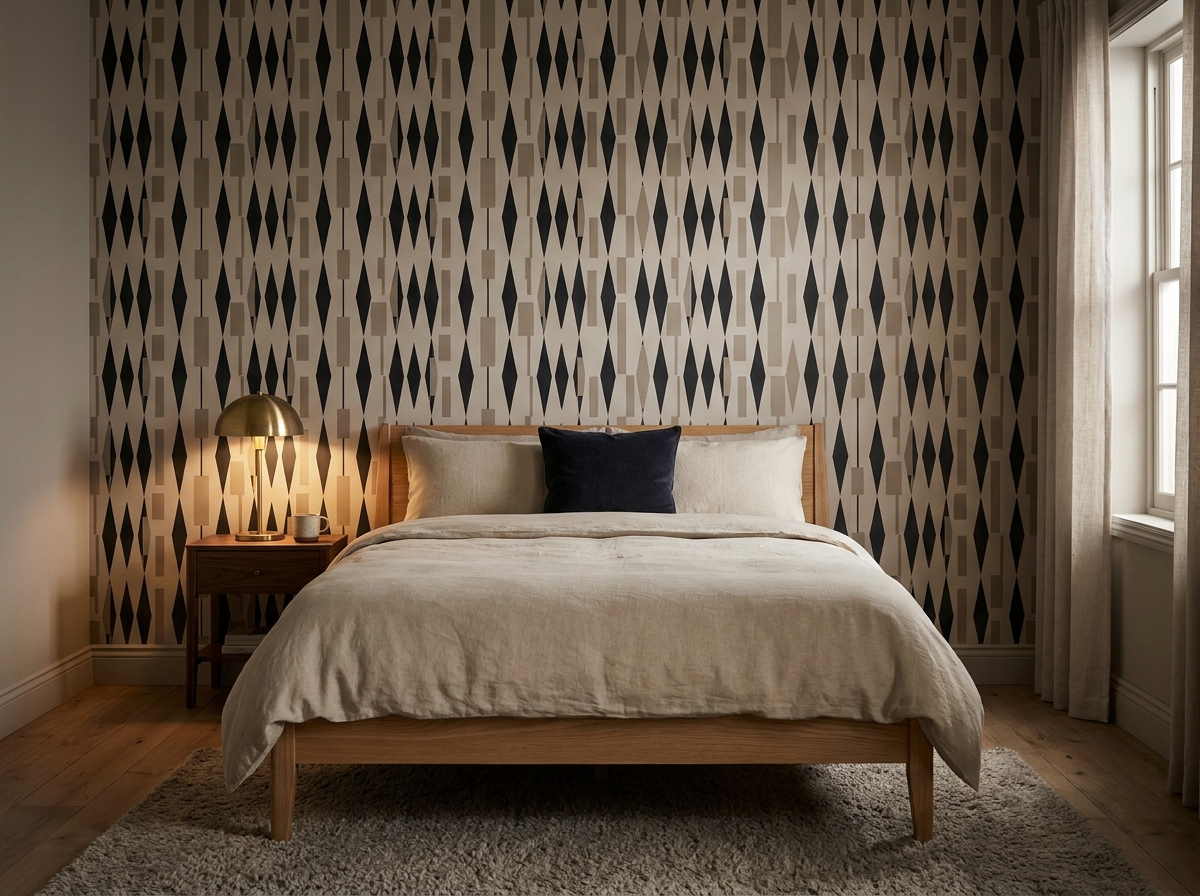
Dark geometrics (greige plus charcoal, midnight blue plus brushed brass, forest green plus cream, espresso plus warm white) are the move when the bedroom feels personality-thin and you want a quiet hotel-suite vibe. They're also the classic trap — a high-contrast geometric on a walnut bed turns the room into a bad hotel knock-off. Apply Rule 4: on dark wood, pick the lowest-contrast geometric in the swatch book (charcoal-on-greige, not black-on-greige).
If you want the same dark geometric energy in a softer register, look at the cozy bedroom decor sibling — the cocooning version of a dark geometric is a tonal greige-on-greige micro-print with washed-linen bedding, not a high-contrast graphic.
Bucket 3 — Stripes and Micro-Prints: 4 Quiet Accent Wall Behind Bed Ideas
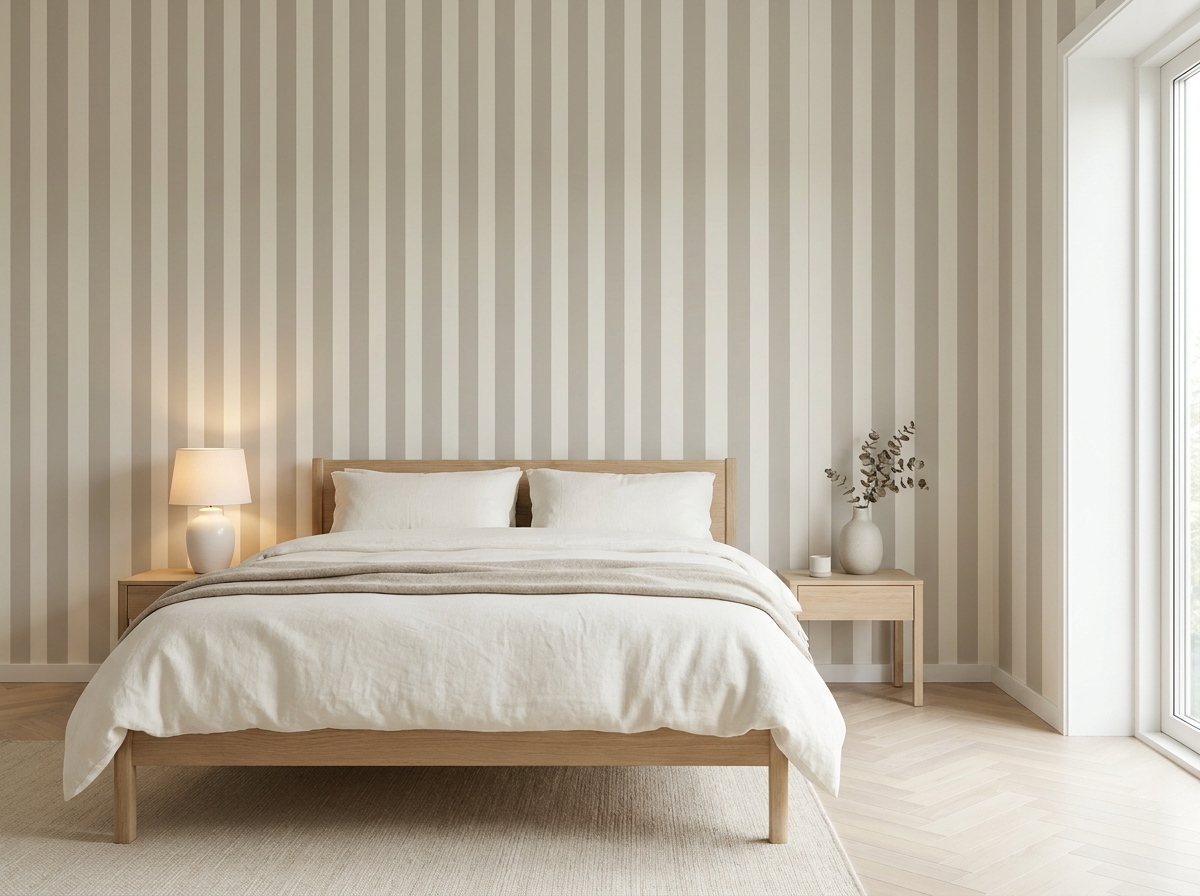
Fine vertical stripes (greige plus ivory, sage plus cream, terracotta plus ecru, dusty blue plus chalk) are the most underrated accent wall behind bed ideas in the entire category. They make the room read taller, they don't impose a single dominant motif, and they play with any bed-wood color. For a bedroom under 130 sq ft / 12 m² or a ceiling under 98 inches / 250 cm, a fine stripe is almost always the right call. Round out the bucket with a micro pin-dot, a small star repeat, or a hand-drawn dash pattern — the absolute calm category.
Peel and Stick Wallpaper Headboard: A Weekend Install
Once the four rules are locked and the pattern is chosen, the install is straightforward — a Saturday with a second pair of hands. Order math: a standard one 33-foot / 10-meter roll covers about 57 sq ft (10 m × 21 inches / 53 cm), which is plenty for a 79-by-98-inch panel with margin for pattern matching. For a full-wall install (about 138 inches × 98 inches = 94 sq ft), order two rolls. For DIY-friendly first-timers, a peel and stick wallpaper headboard is the safest path: removable, repositionable for the first 24 hours, no paste tray, no glue mess. For permanent results, pick a non-woven (Class A) paste-the-wall paper — three times faster than traditional wallpaper and strippable in one piece if you change your mind in five years.
- Pull the bed 24 inches / 60 cm away from the wall — full access to the install zone.
- Snap a vertical chalk line down the center of the bed (not the wall — Rule 3).
- Hang four drops at 98-inch / 250-cm height, working from the chalk line outward.
- Smooth with a soft brush, butt the seams edge-to-edge (never overlap on non-woven).
- Trim baseboard and ceiling with a fresh blade and a metal straightedge, dry 12 hours before sliding the bed back.
The one real trap with panoramic murals: drop numbering. The four drops of a panoramic aren't interchangeable — each is numbered, and the order makes the image. Double-check before you wet a single sheet. That's the number-one reason a $90 roll ends up in the trash.
Test 12 Wallpapers on Your Actual Bedroom Before Ordering
The 12 ideas above are rendered on the same baseline bedroom — useful for honest comparison. But your bedroom isn't the article's bedroom: your bed wood, your daylight, your ceiling height, your existing wall color all change the outcome. With Homeify, you snap a photo of your real bedroom and the AI drops 8 wallpapers in 30 seconds on your real photo — panoramic, geometric, stripe, micro-print, all rendered against your actual bed wood and your actual light. You swipe to compare instead of holding 80 swatch tabs open in two browsers.
A pattern we keep seeing in 2026: most bedrooms tested in Homeify end up with a different wallpaper than the first love-at-first-sight pick. It's not that the original choice was wrong — it's that catalog photos always lie about the light in your specific bedroom. Testing before ordering is an $80 roll you don't end up returning.
Frequently Asked Questions
Does an accent wall have to be behind the bed?
No, but in 90 percent of bedrooms it is the right call. The wall behind the bed is the only wall you can't fill with furniture, which makes it the natural focal point. Picking a side wall instead works only when the bed is centered on a window wall (then the side wall becomes the strongest visual surface). For every other layout, behind the bed wins.
How high should an accent wall behind the bed go?
The wallpaper has to extend at least 30 inches / 75 cm above the headboard. Two clean stopping points: full ceiling-height (always works, gives a cinematic feel) or door-jamb height around 84 inches / 210 cm (high frieze, calm white band above). Anywhere in between looks indecisive — pick one or the other.
Should the accent wall be wider or narrower than the bed?
Always wider — never narrower, never identical. The panel should run 4 to 8 inches / 10 to 20 cm beyond the bed on each side. Queen bed (60 inches): 68 to 76-inch panel. King (76 inches): 84 to 92-inch panel. Beyond that margin, switch to a full-wall install. A panel matching the bed exactly looks shrunken once the pillows go on.
How do you align the wallpaper pattern with the headboard?
Center the pattern on the bed, not on the wall. Snap a chalk line through the middle of the mattress and align the visual axis of the wallpaper — the main bloom on a panoramic, the spine of a graphic, the median strip of a stripe — to that line. If the wall is uneven side-to-side, the pattern reads off-center to the wall but locked to the bed. That's correct. Repeat patterns like fine stripes or pin-dots forgive a 2- to 4-inch shift; panoramics and directional motifs do not.
Does the wallpaper pattern need to match the bed wood?
Match no — coordinate yes. The rule is set by the bed wood: light wood = busy pattern OK (botanical mural, high-contrast geometric, wide stripe), dark wood = desaturated pattern only (soft botanical, monochrome geometric, fine greige stripe). White or no headboard frees you up — anything goes. Upholstered fabric headboard: keep the wallpaper quiet (textured solid, micro-print).
How do I see a wallpaper on my actual bedroom before I buy?
With Homeify, snap a photo of your bedroom and the AI projects 8 different wallpapers — panoramic, geometric, stripe, micro-print — on the wall behind the bed in under 30 seconds, all rendered against your actual bed wood and your actual light. Swipe to compare instead of opening 80 swatch tabs in two browsers.
Related Articles
Was this article helpful?
Download Homeify Free
Transform any room with AI — download Homeify and start redesigning your home for free. The AI room design app trusted by thousands on iOS.
